

Creating Thinkers in a World of Answers: My Journey from Virtual Physics Labs to Immersive Learning Worlds

Dr Singh believes that education should nurture creativity, critical thinking, collaboration, and communication—human competencies that AI cannot generate but must be developed through hands-on experience.
Dr Singh Manpreet
I still remember staring at a grid of student faces on my computer screen while teaching Physics for the Hong Kong Diploma of Secondary Education (HKDSE) at the height of the COVID-19 pandemic. Around me sat the tools of a typical physics laboratory: wires, sensors, lenses, power supplies, and measuring instruments. Normally, students would be gathered around these materials, testing ideas, making mistakes, and experiencing the excitement of scientific discovery. Instead, they were sitting alone at home, attending lessons through Zoom. Those were tough days for everyone.
Like many science teachers, I worried about how practical STEM (Science, Technology, Engineering and Mathematics) learning could survive without access to laboratories during the pandemic. Physics is not a subject that comes alive through memorisation alone. Students truly understand concepts when they investigate motion of objects, build circuits, analyse data, and discover patterns for themselves. Rather than focusing on what had been lost, I began asking a different question: what new opportunities might this crisis create?
To keep practical learning alive, I introduced students to virtual experimentation through interactive online simulation platforms. That year, while teaching physics at a local secondary school using English as the medium of instruction, I redesigned the HKDSE physics experiments on forces, electricity, waves, projectile motion, graphs, and mathematical relationships so that they could be completed in digital environments.

Dr Singh says STEM education fosters curiosity and problem-solving by integrating science, technology, engineering, and mathematics. “Through hands-on experiments and creative problem-solving, students are empowered to move beyond theory, becoming the innovators and thinkers of tomorrow,” he said.
He was no longer trying to complete an assignment; he was investigating.
Initially, my goal was to replicate physical laboratory experiences without stepping into a physical laboratory: a perfect answer to the pandemic, when close human contact was so restricted. What happened next completely changed the way I viewed STEM education. Students began spending far more time experimenting than I expected. Freed from the constraints of limited laboratory equipment and lesson time, they repeatedly adjusted variables, tested ideas, and explored scenarios beyond the lesson's requirements. And among the new fans of my physics class, one student stands out.
After a lesson on projectile motion, one student stayed online long after the class had ended. Curious, I asked him what he was doing. Without looking away from the screen, he replied, "I'm trying to figure out why the graph changes when I increase the angle." At that moment, I realised something had changed in his mind: he was no longer trying to complete an assignment; he was investigating. The simulation was doing more than replacing a laboratory experiment. It was nurturing a curiosity that a traditional experimental setting finds it hard to create. Students were no longer asking, "What is the correct answer?" Instead, they were asking, "What happens if I try this?"
That shift has stayed with me ever since: real learning begins when students become investigators rather than answer-seekers.
As the pandemic continued, I began paying closer attention to how students spent their time outside of school. Many immersed themselves in virtual gaming worlds such as Minecraft, Roblox, and Fortnite. There, they collaborated with friends online, solved quests, faced challenges, and completed missions. While they enjoyed spending their free time playing games, many of the same students struggled to stay engaged during traditional classroom activities. That contradiction puzzled me. Why would students happily spend hours solving problems in virtual worlds but lose interest after just a few minutes working on a worksheet?
Most importantly, the games encourage learners to discover answers for themselves.
The answer gradually became clear: games provide a safe environment for students to explore and fail. In games, they found curiosity, purpose, and rewards. Most importantly, the games encourage learners to discover answers for themselves. That realisation became a turning point in my career. When the pandemic subsided, I joined the Department of Mathematics and Information Technology (MIT) at EdUHK in 2022. While I had entered a new educational environment, the questions I had been exploring during COVID-19 remained with me. In fact, they became even more relevant.

During the pandemic, Dr Singh was invited to share his experience of using simulated experiments in the HKDSE physics curriculum as a superuser of simulations.
The pandemic had made students less vocal in physical classrooms and more active in online forums and virtual worlds. Many of the students I taught at EdUHK came from non-STEM backgrounds. Some had limited experience with engineering, coding, electronics, or scientific inquiry. When I introduced traditional STEM experimental kits and hands-on construction activities, student engagement varied considerably. Some students eagerly assembled physical prototypes. Others appeared hesitant and disconnected.
When I looked more closely, I noticed something interesting. The same reluctant students became highly engaged whenever digital environments were involved. They enthusiastically explored virtual spaces, discussed challenges, experimented with solutions, and collaborated with their peers. As digital natives who had grown up surrounded by smartphones, games, social media, and online communities, they naturally gravitated towards screen-based experiences. This observation led me to another question: what if we worked with students' attraction to digital environments rather than against it?
Instead of viewing digital games as a distraction, they could become a powerful catalyst for learning. This idea gradually shifted my focus from virtual simulations to immersive, game-based learning environments. One of my earliest explorations involved Minecraft Education Edition. Rather than using Minecraft purely as a game, I transformed it into a learning platform where students designed sustainable cities, explored mathematical concepts, and solved STEM challenges collaboratively. The results were immediate.

Dr Singh uses his self-developed virtual platform “The Cardium”, in which students learn abstract science concepts in an immersive game-based learning environment by solving game quests and challenges.
Students who rarely participated in traditional discussions became active contributors. They shared ideas, debated strategies, and worked together to solve problems. Learning felt authentic because it occurred in an environment they genuinely enjoyed. I also began using platforms such as Delightex, Scratch, Blockly Games, and Code.org. These tools enabled students to become creators rather than consumers. They built virtual museums, designed interactive experiences, created digital stories, and demonstrated their understanding through creative projects. Watching students learn through creation convinced me that immersive technologies had enormous potential for education.

Under Dr Singh’s guidance, EdUHK students use the virtual gaming platform Minecraft Education Edition during a STEM learning activity.
Even though these platforms changed students from passive listeners to active participants, I realised that if I wanted learning environments specifically designed around inquiry, STEM exploration, and curriculum-based challenges, I needed to build them myself. That realisation led to the creation of Math City. The idea emerged from a common classroom challenge. Many students viewed mathematics as abstract and disconnected from reality. Concepts of 3D shapes, such as vertices, edges, faces, and spatial reasoning, were often reduced to static diagrams on worksheets. I wondered: what if students could walk through mathematics rather than simply look at it?
In Math City, students explore a virtual city filled with clues, puzzles, and challenges. Rather than passively studying diagrams, mathematics becomes something they experience, not simply memorise. Encouraged by the impact of Math City, I expanded into other disciplines, creating immersive virtual environments that combine game-based learning, storytelling, scientific investigation, and problem-solving. These include The Cardium and Atomic Shadows, which focus on biology and science education. As my work evolved, I became increasingly interested in the possibilities offered by Virtual Reality (VR) and immersive technologies.
Students should not simply receive information. They should discover it.
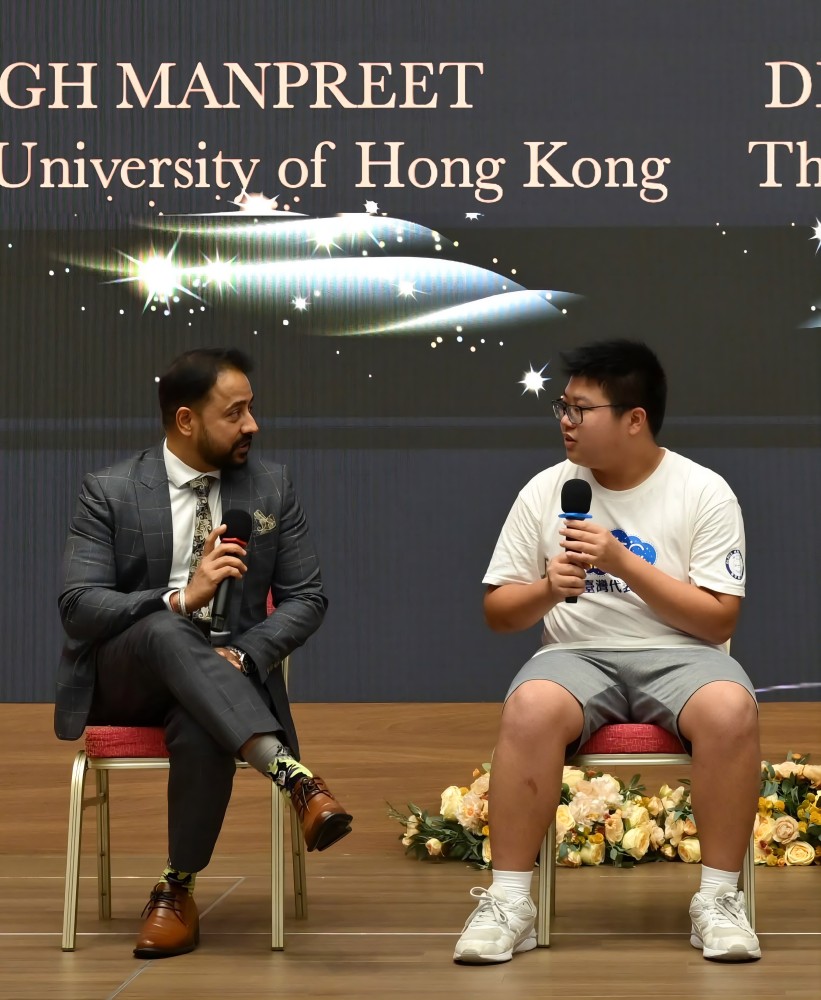
I began creating educational spaces where, using VR headsets and the Unity game engine, students could step inside learning experiences rather than merely observe them. Across all these environments, the philosophy remains the same: students should not simply receive information. They should discover it. That has never mattered more than it does today. Artificial intelligence (AI) can now generate essays, presentations, images, computer code, and reports within seconds, so information has become abundant and easy to access. If technology can provide answers instantly, what should education focus on?
My answer lies in four uniquely human competencies: creativity, critical thinking, collaboration, and communication. These competencies grow naturally within immersive inquiry environments. Students think critically when solving challenges, collaborate when working with peers, communicate when sharing discoveries, and show creativity when designing solutions. AI cannot simply generate these skills. They must be developed through hands-on experience.
Today, these virtual learning initiatives extend beyond my own classrooms. Through outreach programmes, workshops, and STEM projects, they have supported thousands of secondary school students across Hong Kong, including non-Chinese-speaking learners who benefit from the visual and interactive nature of immersive learning. Perhaps most encouragingly, this work has also received international recognition. Math City was shortlisted for the Times Higher Education Awards Asia 2026 and nominated for TIME magazine’s Best Inventions 2026. Meanwhile, the 5E Labs: Human-AI Inquiry Ecosystem for Immersive STEM Learning, which integrates many of these virtual-world and inquiry-based learning principles, was shortlisted for the Global EdTech Prize 2026.

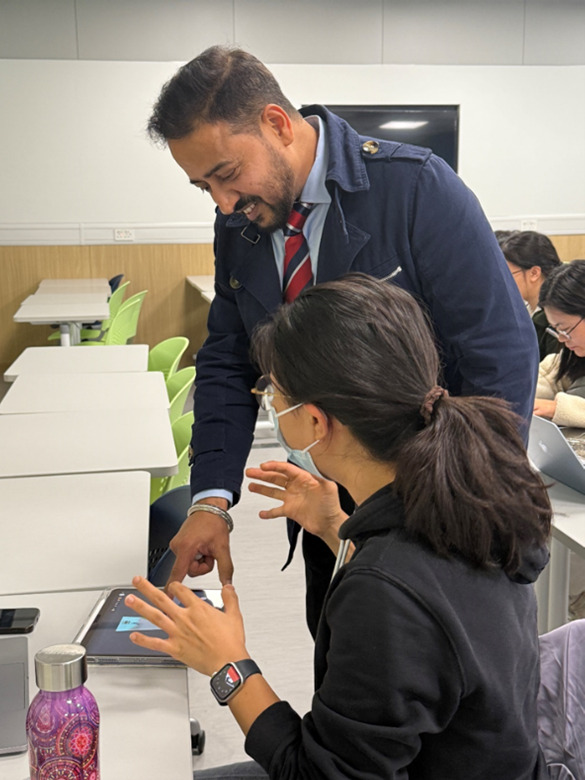
Dr Singh (pictured) discusses with two MIT students how to design an interactive STEM class using a virtual learning platform.
These recognitions are rewarding, but the students are what matter most to me. The student who stayed after class to explore a physics simulation. The student who gained confidence while solving challenges in Minecraft. The student who entered a virtual world believing STEM was not for them, yet left believing they could become a scientist, engineer, designer, or innovator. It is these changes in attitude and behaviour that continue to motivate me. They push me to create platforms where students find fun and excitement in their learning, and to keep going. This work has come further than I ever imagined.
Education should focus more on helping students become explorers, innovators, collaborators, and thinkers who ask their own questions.
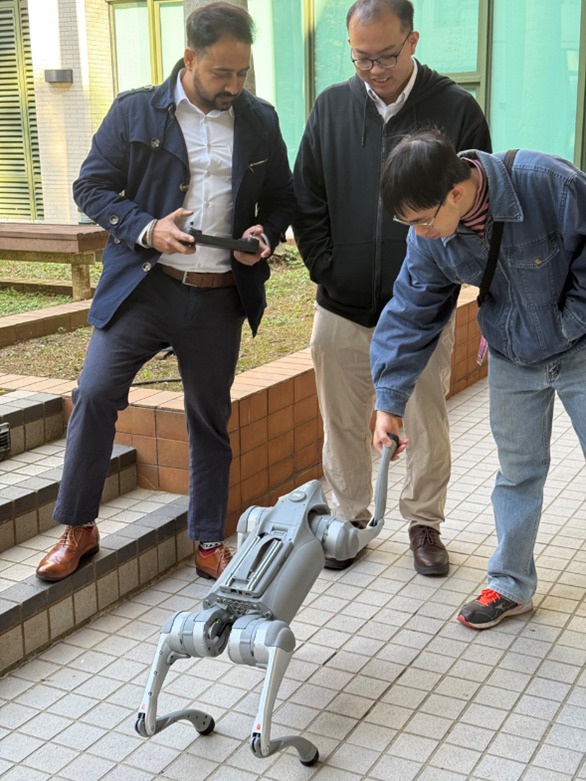
Looking back, what began as an attempt to teach physics experiments during a global pandemic evolved into a broader vision involving virtual simulations, game-based learning, immersive worlds, VR technologies, and internationally recognised educational innovations. Yet despite the technological advances, my purpose has never changed. I want to create learning experiences that inspire curiosity.
In a world overflowing with answers, education should focus less on teaching students how to find information and more on helping them become explorers, innovators, collaborators, and thinkers who ask their own questions. Success in the age of AI will belong to those who ask better questions, imagine new possibilities, and use technology to deepen their thinking rather than replace it.
Note: Dr Manpreet Singh’s research focuses on the fusion of Generative AI, human-AI collaboration, and immersive virtual worlds to create scalable solutions that connect virtual experiences with authentic real-world learning. He has led the development of innovative platforms, including Math City, The Cardium, Atomic Shadows, and the Virtual School of Teachers' Training, reaching thousands of learners through game-based, AI-enabled learning environments that cultivate creativity, critical thinking, and problem-solving skills. He joined EdUHK in 2022.
